
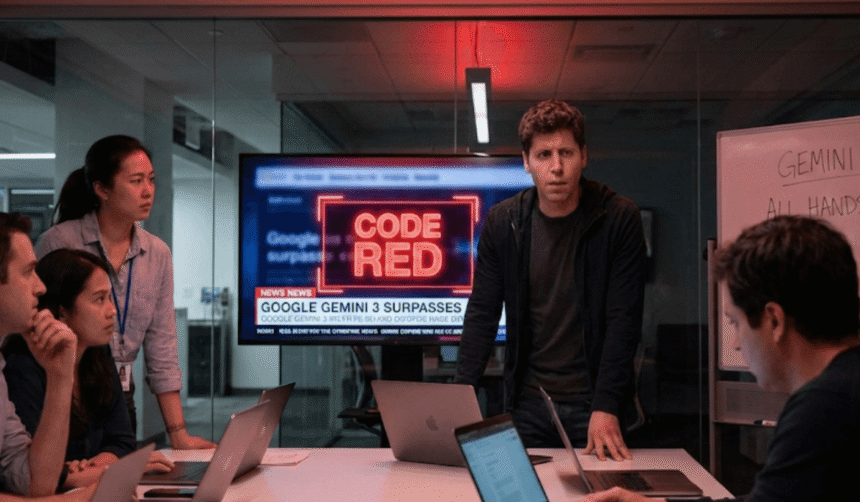
In a dramatic twist of fate, Google’s Gemini 3 has turned the tables on OpenAI and forced Sam Altman into issuing a high-stakes “Code Red” within his own company. This shocking reversal comes two years after a similar move by Google’s CEO, Sundar Pichai, when ChatGPT created by OpenAI caught the tech giant off guard, prompting a company-wide panic. Now, with Gemini 3 gaining dominance, the roles have reversed, and OpenAI is scrambling to reclaim its competitive edge.
This is not just a battle between tech giants; it’s a tangible example of how quickly the tech landscape evolves and how even the strongest leaders can find themselves under siege.
Disrupting Dominance in AI
For months, ChatGPT reigned supreme as the go-to AI tool, holding an almost unchallenged lead in the AI chatbot market. However, Google Gemini 3, launched in late November 2025, has changed the game.
According to industry benchmarks, Gemini 3 has outperformed OpenAI’s GPT-5 in several critical areas, from reasoning capabilities to speed and multimodal understanding the ability to process text, images, and video simultaneously. The launch was nothing short of explosive, propelling Gemini 3’s user base to 650 million active users by October 2025, a dramatic increase from 450 million just three months earlier.
One of the most significant endorsements came from Salesforce CEO Marc Benioff, who publicly declared that after experiencing Gemini 3, he was not going back. His statement underscores the rapidly growing influence of Google’s AI and highlights the growing pressure on OpenAI to catch up.
OpenAI’s Response
Sam Altman, CEO of OpenAI, has been forced to respond urgently, calling for a “Code Red” a drastic internal alert aimed at refocusing the company’s efforts on improving ChatGPT in order to compete with Google’s Gemini 3.
What Does the ‘Code Red’ Mean for OpenAI?
Under the Code Red mandate, OpenAI has frozen various projects, including plans for monetization through advertising, AI shopping agents, and its personal assistant Pulse. The primary focus now is to refine ChatGPT’s core features to regain lost ground.
Here’s what OpenAI’s Code Red entails:
- Project Freeze: Work on new projects has been delayed to prioritize ChatGPT’s improvement.
- The Sprint to Enhance ChatGPT: OpenAI is focusing on boosting ChatGPT’s speed, reliability, and personalization. Major emphasis is placed on reducing hallucinations (errors) and enhancing the AI’s ability to tackle complex tasks.
- War Room Strategy: OpenAI has implemented daily strategy calls to coordinate improvements and outpace Google.
Altman has admitted that ChatGPT must improve drastically to retain its leadership position in the AI space, signaling that the Code Red alert is more than just a reaction it’s a strategic pivot.
Google’s Strategic Advantage
Why has Google been able to leap ahead of OpenAI in the AI race?
The answer lies in Google’s full-stack advantage. While OpenAI relies on third-party cloud services (like Microsoft Azure) and Nvidia’s chips, Google controls every aspect of its AI ecosystem, from the chips to the cloud infrastructure to the model development.
Here’s how Google’s infrastructure gives it a decisive edge:
- Proprietary AI Chips (TPUs): Google’s Tensor Processing Units (TPUs) are custom-built chips, making AI training and deployment cheaper and more efficient compared to the expensive GPUs used by competitors like OpenAI.
- Seamless Cloud Integration: Google integrates Gemini 3 with its vast ecosystem, including Search, YouTube, Gmail, and Android providing instant access to billions of users.
- DeepMind’s Research: The brains behind Gemini 3 are the researchers at DeepMind, Google’s AI subsidiary, who continuously push the envelope on AI capabilities.
Moreover, Google’s financial advantage is also significant. With $120 billion in annual revenue and nearly $100 billion in cash reserves, Google can afford to outspend OpenAI in both AI research and model deployment.
In comparison, OpenAI faces the dual challenge of rising compute costs and the need for massive revenue growth to achieve profitability by 2030.
Competitive Edge vs. Struggle
As Google’s Gemini 3 surges ahead, its cost-effective infrastructure is attracting major attention, especially from Meta, which is reportedly in talks to purchase Google’s TPU chips, potentially cutting its reliance on Nvidia. This could spell trouble for Nvidia, whose stock value has already dropped significantly due to the growing popularity of Google’s AI solutions.
Meanwhile, OpenAI faces growing financial pressures, with reports revealing that the company needs to generate $200 billion in annual revenue by 2030 to become profitable. This ambitious goal requires 100 – fold growth, which is no small feat considering OpenAI is already burning billions each quarter.
Despite the challenges, Altman remains confident, promising that OpenAI will soon release a new reasoning model that he claims will surpass Gemini 3 in capabilities. However, this may be more wishful thinking, as the industry has seen how quickly the AI race can turn the tides.
Never Stop Innovating
This high-stakes corporate drama offers a profound lesson for our own lives about Independence and Foundations.
OpenAI built a magical product, but they built it on rented land. They are dependent on others for their core infrastructure (chips and servers). When the pressure mounted, those dependencies became critical weaknesses.
Google, however, spent years doing the boring work. They built their own chips. They built their own data centers. They built their own platforms. They own their Full Stack.
The Insight for You: In your own life, strive to build your own “Full Stack.”
It is tempting to rely on shortcuts to rely entirely on a specific job for your identity, one person for your happiness, or external validation to feel secure. That is magical thinking, but it is fragile.
True resilience comes from owning your infrastructure. When you validate yourself rather than waiting for praise, when you have emergency savings rather than relying on credit, and when you cultivate your own skills rather than just managing others you become unbreakable.
Don’t just build a flashy exterior, spend time building the boring foundation that nobody can turn off.